Summary of the Book
For a summary of the entire book, it would be in order to begin by first summarizing the story of Pakistan’s eleven elections. That would in turn lead us to summarizing our interpretation of why the three hundred million men and women who participated in one or more of these elections voted the way they did.
The Story of Pakistan’s Eleven Elections with One Lesson: Pakistani elections are a process without a product.
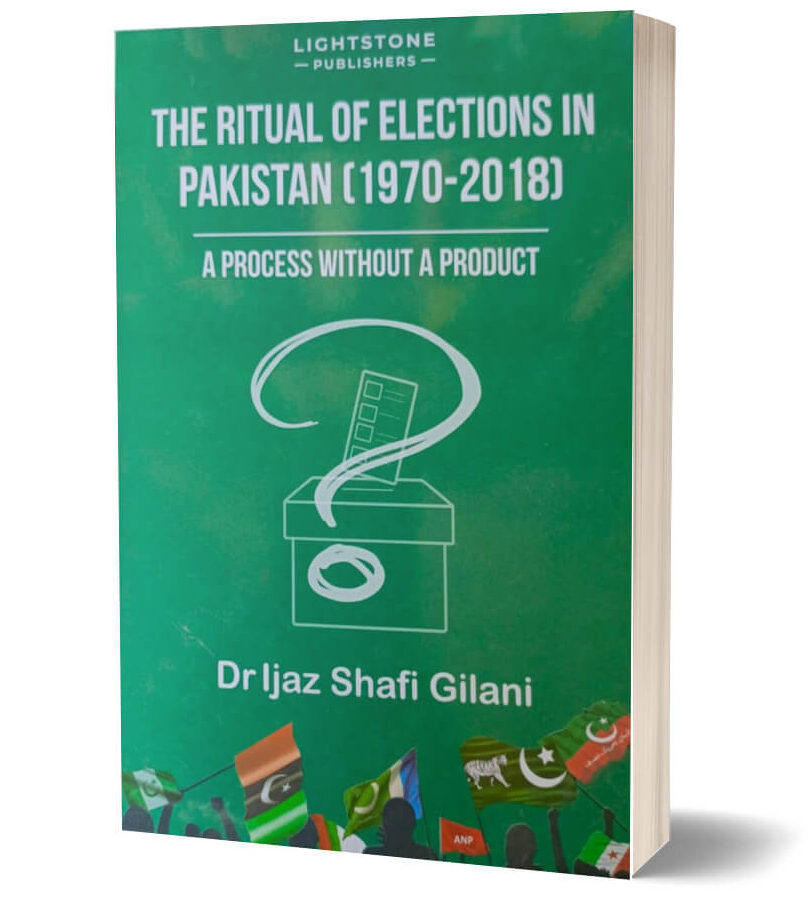
The one lesson we put forth is that, so far, elections in Pakistan have been a reasonably well performed ritual held on the average every four years since 1970. The problem is not with the quality or the correctness of the ritual. Instead, what troubles the polity is that this ritual is a process which delivers no product. The process moves in a circular fashion whereby it returns to the starting point at the end of each cycle without a forward movement. In other words, it delivers no tangible product in terms of any concrete progress on the road to democratic or constitutional order. What is our evidence?
Our evidence comes from a close reading of each one of Pakistan’s eleven elections. Part Two comprises eleven chapters, each of which gives a bird’s-eye view of an election and the tenure of the government which was formed as a result of that election. Each chapter has been a given a title and subtitle which exhibits the essence of that election as it relates to its process, outcome and impact on the political life of the country. Each chapter includes a simple-to-read table on the electoral outcome showing the vote scores of all the major parties at an all-Pakistan and provincial level. A hyperlink provides immediate access to the election results at sub-provincial level such as the administrative divisions of the country.
Throughout the book, we make extensive use of hyperlinks for providing access to detailed information for the research community.
Our reading is that, with minor exceptions, each one of the eleven national elections (1970-2018) went through seven stages mimicking the seven acts of a multi-episode play. The plot of the play is that the story invariably returns to the starting point of the previous episode. The plot does not move forward progressively. Thus, elections are announced, an election campaign goes through its motions and the electoral contest is conducted which leads to the formation of a government. Despite several hiccups on the way, an elected government begins to function. After a short while, tensions arise between the elected and the unelected sections of government. As tensions mount, the role of the elected government is terminated before it has completed its statutory term. This leads to a period of uncertainty about the future course. Nevertheless, the uncertainty settles down and fresh elections are called. The seven acts of this play move on to repeat themselves with minor cosmetic changes.
Three reasons why Pakistani elections deserve serious academic research
- Flaws apart, Pakistani elections are, more often than not, a good measure of popular opinion at the time. The analyses put forth in this book suggest that the process of Pakistani elections is sufficiently accurate to be a good measure of popular public opinion. That aspect in itself makes them worthy of academic research.
- Even when elections do not deliver democracy or good government, they are a source of nourishing and periodically energizing Pakistan’s grass root society and its socio-political structures.
- Pakistani elections have kept alive the idea of lawful constitutional government and equality of Pakistanis across social divide.
The three reasons mentioned above have led us to engage in treating Pakistani elections with serious academic attention, analyzing the behavior of the approximately 300 million voters who cast their votes since 1970. In the following pages, we highlight our key findings.
What motivates voters?
Our observation is that the voting behavior of Pakistan’s various socio-economic groups or classes are not vastly different from each other. And yet their understanding is critical for the active political parties and players. The shifts are slow and take place over an extended period of time after which they play a critical role in disrupting the prevailing balances in electoral landscape.
There are three factors which together influence voter decision making. These are, firstly, Desires about choosing the candidate who they believe is in their best interest; secondly, the socio-economic Drivers which shape the voting inclinations of the voter and, thirdly, the specific Political Contexts in which a given election is held. In conclusion, as far as the voter’s individual decision is concerned, it is made at the confluence of Desires, Drivers and Political Contexts.
How voters congregate into political parties; what has been their structure and performance over the last fifty years
Beyond individual choices, how do voters congregate around a certain political party? In other words, what turns individual votes into “vote banks” as demonstrated in each of Pakistan’s eleven elections. For this purpose, the size of the vote banks of all the major political parties of Pakistan is introduced in the book.
To provide an insight into the structure of political parties in Pakistan, we identify four tiers of political structures. These are further divided into two layers. The first layer comprises tier 1 and tier 2. Despite being the foundational tiers, their status in the entire structure is one of disempowered under-dogs. The character of both of these tiers is an informal mix of being a community and a political group. Even though the first layer is the foundation of Pakistan’s political parties, it lacks a formal status. The formalization of the foundation layer is hard to come by as long as sub-provincial governments are not empowered. This subject has been elaborated as part of the reflections on why political parties remain weak and elections fail to deliver democracy.
The second layer comprises tier 3 and tier 4. The book presents an in-depth description of this layer in Chapter 2. The structure of this layer is discussed in part one of the second chapter whereas the data on the electoral performance of both the tiers is provided in an appendix to the same chapter. However, it leaves out any discussion about the identity of each political party and its party cluster. That subject is addressed later.
The term ‘party cluster’ refers to a group of parties consisting of a founding party as well as its breakaways. Furthermore, the term includes political parties which share an idea as a result of which they are seen as like-minded parties. The concept of party cluster has emerged from our close study of voter behavior from one election to another using both Gallup Exit-Poll survey data and Election Commission of Pakistan (ECP) voting record data.
In addition to the two sources mentioned above, the Gallup & Gilani Index of Electoral Record and the Gallup & Gilani census of Pakistan’s Political Class are two important datasets used for this discussion.
What is the bond which binds political parties?
Based on our analysis of the eleven elections on the same canvas, we raise the question: is there a common identity bond through which individual voters club into vote banks and in turn vote banks congregate within the parameters of a certain family of voters? As the size of vote banks increases, an identity bond comparable to a ‘spiritual’ family becomes more powerful than a transactional interest-based, patronage-seeking bond which is nevertheless strong at the bottom of the pyramid of vote banks.
Looking through fifty years and eleven elections in the history of Pakistani Politics, five clusters or families of vote banks can be identified, each woven around an identity bond. Three of these five identity clusters are perennial or constant in nature. They are named as the idea of the State of Pakistan, the idea of the Islamic State of Pakistan and the idea of the Federal State of Pakistan. The idea of a concept or aspiration for the State of Pakistan has been voiced most distinctively by the Muslim League(s), an aspiration for the Islamic State of Pakistan by the Religious Parties and an aspiration for the Federal State of Pakistan by the respective Regional Parties.
Besides these three perennial-permanent identity clusters, Pakistani electoral politics has so far birthed two disruptive-transformational identity clusters, the PPP identity cluster which surfaced in 1968 and the PTI identity cluster which surfaced thirty years later in 1996. We attribute the disruptive-transformative political identities to the socio-economic transformation over several decades. Chapter 3 of the book explains how the disruption of the political map of the country is responded to and creatively restored by the perennial party clusters.
All identities tend to overlap and voters hold more than one identity but are mostly inclined towards one more than the others. Once they become a part of the voice of that specific identity, their identity bond takes up a life of its own.
Depending on their internal vitality, a given political context and, most importantly, alliance- building or alliance-switching behaviors have led to the rise, fall and resurgence in the electoral fortunes of these five electoral identity clusters.
From scoring votes to reaching the National Assembly
It is important to discuss the subject of how votes are converted into representation in the assemblies or the national and provincial assemblies’ seats. While it might appear simple on the face of it, the conversion of votes into seats is highly complicated. It requires fairly elaborate statistical thinking. For this purpose, the Gallup and Gilani Model of Electoral Calculus has been introduced. This model comprises the interplay of four variables; firstly, party vote banks; secondly, the delineation of Pakistan’s twelve electoral territories; thirdly, three types of polarity, each of which describes the type of competition between the leading political parties at an electoral territory level and, finally, the rules which convert votes into seats in parliament.
Five key learnings on voters’ decision-making process
- Voting decisions are not the momentary outcome of any one behavioral, structural or contextual factor. Instead, voting decisions are the result of a process which may span over one or more than one electoral campaign.
- Voting decisions may initially originate at a personal level influenced by a variety of factors. However, once the voter has voted for a party in one or more elections, the party becomes a marker of their personal identity. From thereon, party identification takes on a rather stable role.
- Voters periodically switch to another party but, in general, they switch to a party which falls within the same identity spectrum as the one from which they switched.
- Occasionally, voters migrate from one cluster of parties to another. This generally happens when the broader socioeconomic landscape of the country undergoes a transformation. In our narrative of each one of Pakistan’s eleven elections, we have spotted such transformative moments under the title: Changes in the Big Picture.
- Over several generations, we observe that a totally fresh identity cluster emerges. Since the inception of Pakistan, only two new party clusters have surfaced: the PPP cluster in 1970 which voiced the concerns of what we have described in this book as a constituency of the new-poor and the PTI cluster in 2013 which voiced the concerns of the new-educated. When a new cluster emerges successfully and disturbs the prevailing balances, the existing party clusters end up in realigning themselves and reinventing their identities.
Can elections deliver democracy and good government?
This is the heart of the theoretical part of this book. It deals with the role of governmental authority within the larger context of an overarching society. How does a society create and share power and make rules for that purpose? In Chapter 5, we comprehensively describe three generic pillars of any political system designed for a society of equal citizens
There are three factors which shape a given power-sharing order. These are; foundational, instrumental and contextual. Chapter 5 of the book discusses the interplay of these three factors with reference to the liberal democratic model which originated in Europe but has since gained a degree of world-wide appeal. We analyze the promise and peril faced by the liberal democratic mode both on its home ground and in the rest of the world.
The three foundational or the generic pillars are: the will of the people, an effective administration to enforce the will of the people through lawful instruments of coercion and a social class of elders to ensure that the will of the people and the coercive institutions carry social legitimacy to make the design acceptable. Having determined the three generic requirements of any system of government where people are at the center stage, we examine its execution under the classical liberal democracy which has functioned quite effectively in Western Europe and North America for over two hundred years. We identify a set of instrumental and contextual factors which were essential for the success of the WENA model of liberal democracy.
Defining the three generic pillars and instruments of the WENA model of democracy raises two questions; firstly, has the WENA model of democracy been successfully replicated in the larger world outside of WENA and, secondly, what explains Pakistan’s failure to replicate the WENA model of liberal democracy. Our brief answers to these questions are provided in Chapter 5.
From providing our descriptive analysis and reflections of the past fifty years of Pakistan’s electoral history, we move on to conclude by reflecting on the present and future of democracy and good government in Pakistan.
THE CONTENT BELOW IS ALREADY GIVEN IN THE EPILOGUE. IT IS REPETITION AND SHOULD BE GIVEN ONCE IN THE BOOK
As the book is sent to the press, Pakistan is completing the eleventh round of its electoral history and is on the road to the twelfth national election. We reproduce below the Epilogue to this book which includes seven reflections on Pakistan’s prevailing political crisis.
Epilogue: The road to Pakistan’s twelfth national election and beyond
The eleventh round of Pakistan’s national elections “2018-23” faced the same fate as the previous ten. It went through the seven acts or rituals which we have identified in this book. The process climaxed with the familiar tensions between the elected and the unelected arms of the government resulting in the breakdown of the system. The political government was back to square one without making much headway towards democracy and good government.
Despite its similarity with the previous ones, the eleventh round was distinctive on one important count. It gave birth to what we have identified in Chapter 3 as a disruptive political cluster. The emergence of PTI as a disruptive political cluster has parallels with the emergence of PPP in the 1970 elections with one difference. PPP voiced the demand of the poor for a share in ‘prosperity’. Conversely, PTI has voiced the demand of the middle and upper classes for a share in ‘power’. It is important to note this difference because that would influence the transformative actions necessary to restore an atmosphere suited for competitive politics and multi-party democracy.
Given this background, we conclude the book by presenting a set of reflections on Pakistan’s current political crisis. Those are presented as part of an Epilogue which comes at the end of the book. Our view is that the twelfth national elections scheduled for February 8, 2024 are a welcome step. They are unlikely to resolve the current political crisis, but can possibly provide an interlude for the political restructuring necessary for resolving it. A set of seven reflections summarize our analysis about the nature of the current political crisis and a proposed path to resolve it. The proposed pathway laid out for initiating a dialogue on the subject can be treated as a modest contribution of this short treatise.